
Overview Summary
- Short-range wireless communication has become a standard feature in many modern law enforcement technology platforms, commonly associated with Bluetooth-enabled devices.
- Wireless-enabled systems must be designed with security, controlled data transmission, and operational privacy in mind.
- Recent industry concerns have highlighted how improperly implemented wireless communication can expose sensitive identifying information.
- The Argus Video Platform was engineered with a fundamentally different wireless communication approach focused on minimizing unnecessary exposure.
- Kustom Signals systems transmit only limited trigger-related data for brief durations using proprietary communication methods.
- Agencies evaluating modern enforcement technology should carefully examine how vendors handle wireless communication, metadata exposure, and device discoverability.
Wireless Security Is a Growing Concern
Modern law enforcement technology increasingly relies on short-range wireless communication to improve operational efficiency, simplify device interaction, and streamline evidence workflows. Body-worn camera systems, in-car video systems, digital evidence platforms, and integrated enforcement technologies all benefit from fast device-to-device communication capabilities.
At the same time, agencies are becoming more aware that wireless connectivity introduces important security and privacy considerations that should be evaluated carefully during procurement and deployment.
Recent industry discussions surrounding wireless device discoverability have raised broader questions about how law enforcement technology manufacturers design, manage, and secure communication between devices. These conversations have reinforced an important reality for agencies: not all wireless implementations are designed the same way.
For agencies responsible for protecting officers, operational data, and evidentiary integrity, understanding how wireless communication functions behind the scenes is becoming an increasingly important part of evaluating technology platforms.
Understanding Short-Range Wireless Communication in Public Safety Devices
Many modern public safety technologies rely on short-range wireless communication to support functions such as trigger synchronization, accessory communication, status signaling, and evidence workflow automation.
While these capabilities improve operational efficiency, agencies should also evaluate how wireless communication is implemented. Key considerations include:
- What information is transmitted?
- Are devices continuously discoverable?
- What metadata may be exposed?
- How is operational privacy protected?
As wireless-enabled systems become more common, these considerations are becoming increasingly important during technology evaluations.
Why Wireless Device Discoverability Is a Growing Concern
One of the primary concerns associated with wireless-enabled devices is discoverability. In simple terms, discoverability refers to whether outside devices or applications can detect nearby equipment and identify information about it.
If improperly implemented, wireless communication systems could potentially expose information such as:
- Device identifiers.
- Hardware serial numbers.
- Device model information.
- Persistent device signatures.
- Operational presence.
- Potential location-related information.
For law enforcement agencies, this creates concerns regarding officer privacy, operational awareness, and situational security. Even when no direct evidence data is exposed, continuously broadcasting identifiable device information may create unnecessary operational visibility that agencies would prefer to avoid.
As agencies modernize their fleets and evidence platforms, procurement leaders are evaluating not only functionality and evidence quality, but also the communication security architecture behind the systems themselves.
How Argus Video Platform Takes a Different Approach
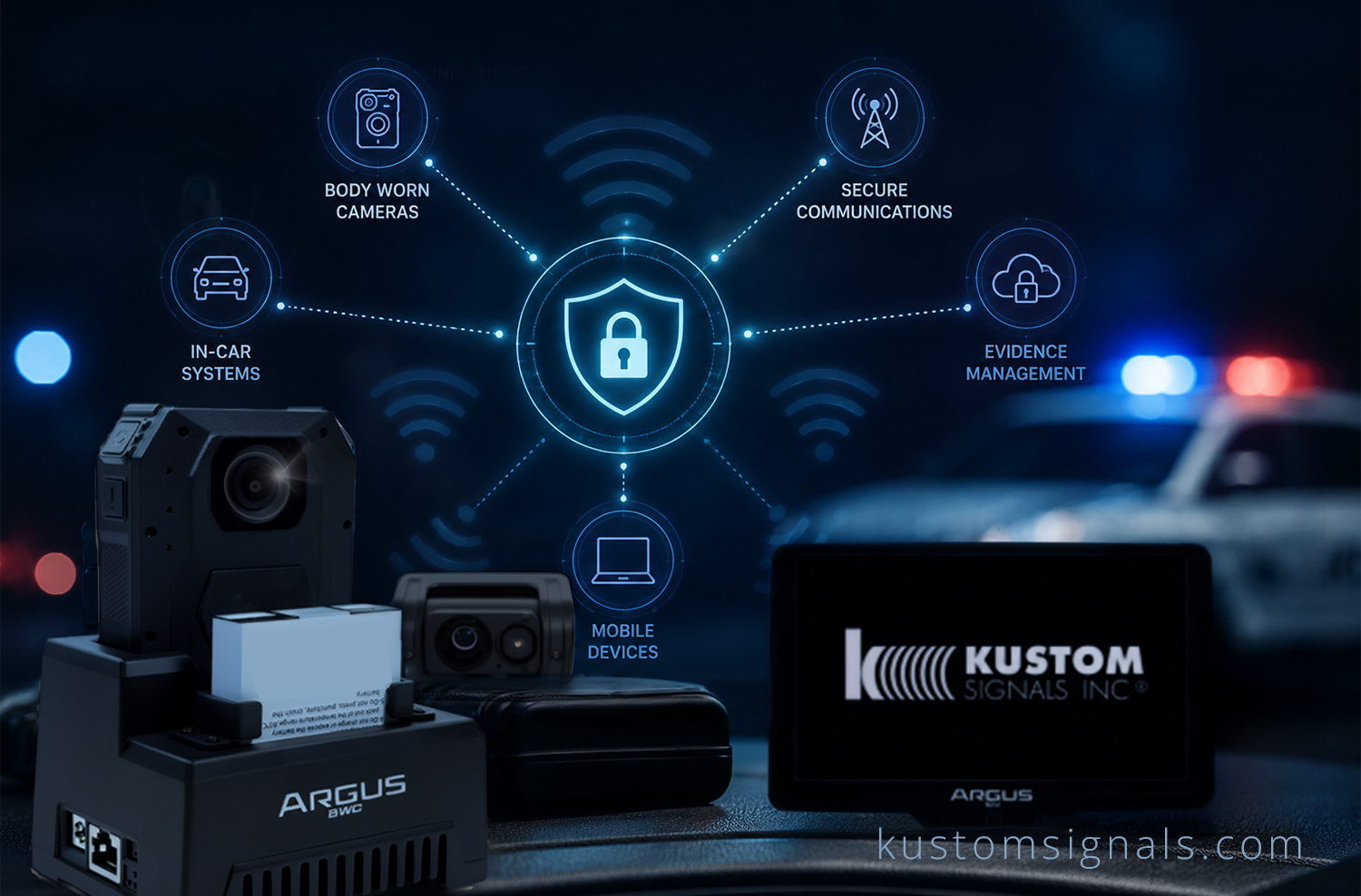
Kustom Signals designed the Argus Video Platform, including Argus Police Body Worn Cameras, Argus In-Car Video, and Argus Data Vault, with a fundamentally different philosophy regarding short-range wireless communication.
Rather than relying on continuously discoverable public wireless signaling, the Argus platform minimizes exposure opportunities through several important design characteristics.
Brief, Limited Communication Windows
Argus Video Platform devices transmit low-powered wireless signals only for short operational durations when triggered. These transmissions occur during brief windows measured in seconds rather than through continuous broadcasting.
This reduces opportunities for outside detection or monitoring.
Proprietary Communication Protocols
The Argus Video Platform uses proprietary communication methods rather than openly accessible public communication structures.
Identifying or interpreting these transmissions would require specific knowledge of the proprietary protocol being used. The communication is not designed to provide openly readable operational data to nearby third-party devices or applications.
Minimal Data Transmission
Kustom Signals also limits the information transmitted during these wireless communication events. The transmitted information is restricted to only the values necessary for the trigger-related operation and the device serial number associated with that communication event.
Importantly, the system does not transmit:
- GPS location information.
- Officer identification data.
- User account information.
- Operational assignment information.
- Tracking metadata.
- Broader evidentiary information.
Even in the unlikely event that a transmission were intercepted during its short communication window, the information would provide little operational value.
Evaluating Technology Beyond Features Alone
As public safety technology continues evolving, agencies are increasingly recognizing that communication security architecture matters just as much as feature lists.
Wireless communication capabilities can provide significant operational advantages, but only when implemented responsibly and thoughtfully. Agencies evaluating body-worn camera systems, in-car video platforms, and integrated evidence technologies should understand how vendors approach wireless signaling, metadata exposure, device discoverability, and operational privacy.
Performance and Security with Kustom Signals
The Kustom Signals approach to wireless communication within the Argus Video Platform reflects a broader design philosophy focused on:
- Operational security.
- Controlled data exposure.
- Officer privacy.
- Evidence integrity.
- Responsible system architecture.
- Practical real-world deployment considerations.
This approach aligns with the needs of agencies seeking modern integrated technology platforms without introducing unnecessary operational exposure risks.
Kustom Signals continues to develop public safety technologies designed around reliability, evidentiary strength, operational efficiency, and secure system architecture, including:
- Argus Body-Worn Camera (BWC)
- Argus in-Car Video (Argus IVC)
- Argus Data Vault (ADV)
- Eagle 3 In-Car RADAR
- ProLaser 4 Handheld LIDAR
To learn more about the Argus Video Platform and Kustom Signals integrated enforcement technologies, contact Kustom Signals to discuss your agency’s operational and security requirements.